Clan Campbell
The surname Campbell comes from the Gaelic cam beul, meaning “crooked mouth” or “wry mouth” established [oxfordFNBI] — originally a personal nickname, not a place or title. The genteel derivation from Norman French de Campo Bello (“of the beautiful field”) is a later, flattering invention: it is rejected by modern linguistics, which finds no evidence for a Norman origin and clear Gaelic phonetics in the earliest forms established [oxfordFNBI] . This is a useful reminder that a surname’s sound is a poor guide to its origin, and that families often reached for grander etymologies than the truth.
Legendary origins
In Gaelic tradition the clan is Clann Diarmaid, the children of Diarmid — claiming descent from Diarmid O’Duibhne, a hero of the Ossianic legends said to have slain a great boar in Kintyre. This is legendary genealogy, not documented descent contested [wikidata] : it belongs to the world of medieval Gaelic storytelling, and no historical line connects the clan to a figure of myth. We record the tradition; we do not present it as fact.
Documented origins
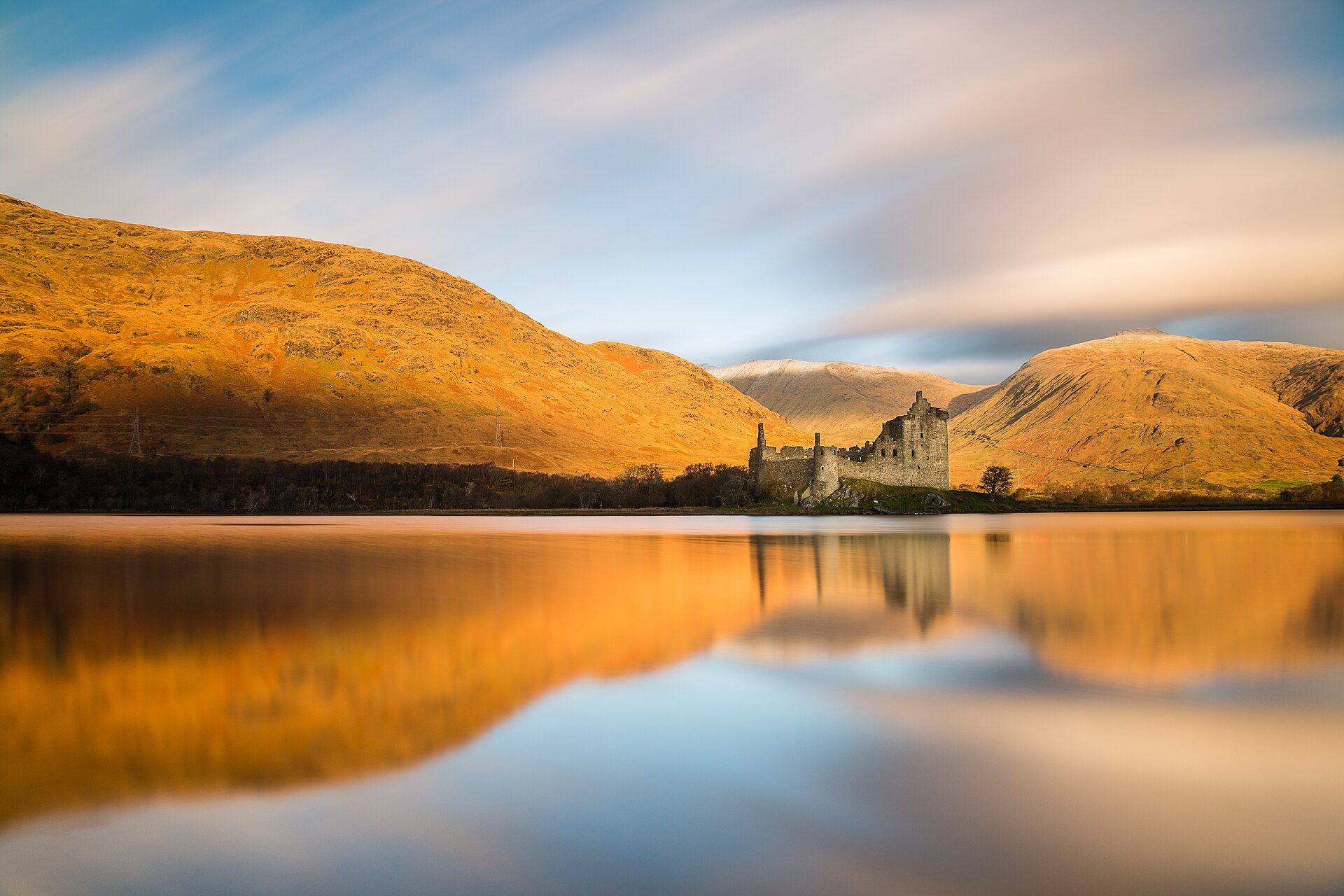
The historical record is later and firmer — and we can point to the charters. The earliest well-attested Campbell is Gillespie (Gilleasbaig) Campbell, on record by 1266 established [poms] , the family’s power rooted at Loch Awe in Argyll, with the island fortress of Innis Chonnell an early seat. It was Sir Colin Campbell — Cailean Mór, “Great Colin” — attested through the 1290s and, by tradition, killed around 1296 established [poms] who gave the chiefs their enduring Gaelic style: MacCailein Mór, “son of Great Colin,” a title still used of the clan’s chief today established [wikidata] .
By 1296 the Campbells were a knightly power in Argyll. When Edward I of England took the homage of the Scots, Campbells were among those who swore fealty in the Ragman Roll — the roll names Nicol Cambel and Dunkan Cambel del Illes (“Duncan Campbell of the Isles”) established [ragmanRoll1296] .
Rise to power — and the rivalry with Clan Donald
The Campbells’ ascent was built less on conquest than on alignment with the Crown. Where the MacDonald Lords of the Isles set themselves against the kings of Scots, the Campbells generally served them — and were rewarded, expanding across Argyll and the western Highlands, often into lands and lordships once held by Clan Donald probable [wikidata] after the forfeiture of the Lordship of the Isles in 1493. The two clans became the great opposing powers of the west, and their enmity runs through centuries of Highland history.
Its most notorious episode was the Massacre of Glencoe in 1692, when soldiers under Robert Campbell of Glenlyon killed members of the MacDonalds of Glencoe who had sheltered them established [wikidata] — carried out on government orders, but long remembered as a Campbell betrayal.
Status today
Clan Campbell is a living clan. Its chief, the Duke of Argyll, is recognised by the Court of the Lord Lyon established [lordLyon] , with the ducal seat at Inveraray Castle on Loch Fyne. Major branches include the houses of Argyll, Breadalbane, Cawdor, and Loudoun.
Sources
-
[poms]People of Medieval Scotland, 1093–1371 (PoMS), poms.ac.uk (AHRC / Leverhulme; King’s College London & Univ. of Glasgow). Academic prosopography; publishes Linked Open Data (RDF). Used as a finding aid over public-domain charters. · link -
[ragmanRoll1296]The Ragman Roll — instruments of homage and fealty of the Scots to Edward I of England, 1296 (ed. Bannatyne Club, 1834). Public domain (medieval documents; 1834 printed edition) -
[wikidata]Wikidata. CC0 1.0 (public domain) · link -
[oxfordFNBI]Hanks, Coates & McClure (eds.), The Oxford Dictionary of Family Names in Britain and Ireland (OUP, 2016). Proprietary (OUP) — read & paraphrase + cite, never copy entries -
[lordLyon]Court of the Lord Lyon — official roll of clans and chiefs. Crown copyright / unclear — cite, do not scrape · link