Clan Fraser
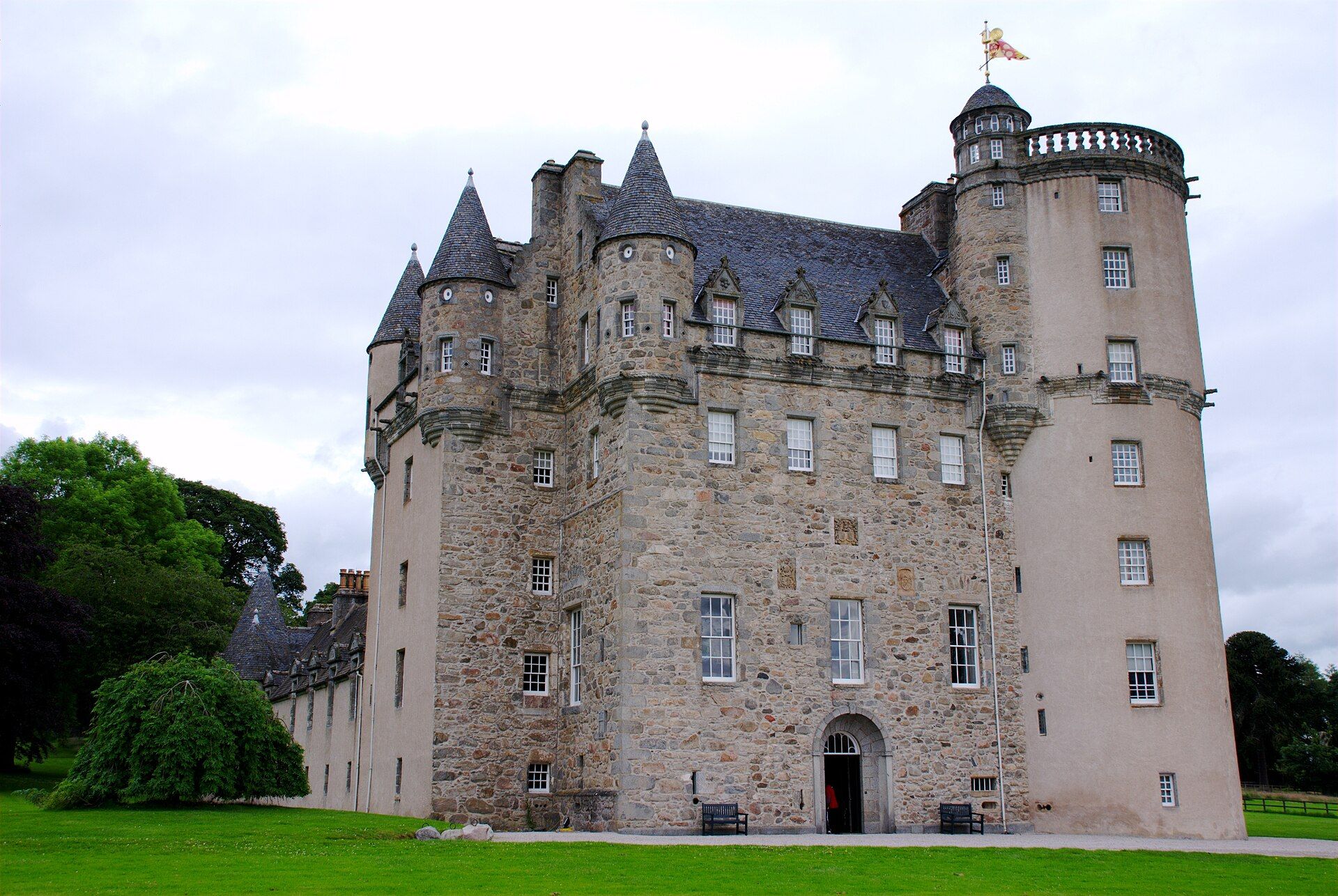
Clan Fraser is a striking example of something the popular idea of a “Highland clan” tends to obscure: its founders were not ancient Celts but incoming Normans. The name first appears in Scotland in the mid-12th century as de Fresel, de Friselle and de Freseliere — forms that mark it as Norman French, the family probably arriving from France established [oxfordFNBI] . Only later did the Frasers move north, take root in the Highlands, and become Gaelic-speaking — Frisealach in Gaelic.
The earliest records — a Border family, not a Highland one
We can put names and dates to this from the charters themselves. The earliest documented Frasers appear not in the Highlands but in the abbey charters of the Borders and Lothian: Gilbert Fraser and his wife Christiana, granting land in a charter of 1164×1171 (Brinkburn Cartulary, no. 156) established [poms] — the oldest surviving record of the name in Scotland — followed by a documented line running Udard Fraser → Adam Fraser → Laurence Fraser, in grants to Newbattle Abbey around 1190–1230 (Newbattle Registrum, nos. 77–78) established [poms] . Their world was Roxburgh, Berwickshire and Midlothian, not the glens.
This matters for how the clan is usually sold: the family’s documented roots are Lowland and Border, and the Highland Frasers of Lovat are a later offshoot — which is exactly why “ancient Highland clan” is the wrong frame. By the end of the 13th century the Frasers were numerous and powerful: when Edward I of England took the homage of the Scottish political community, a whole cohort of Frasers — among them Sir Alexander Fraser, Sir Richard Fraser and Simon Fraser — swore fealty in the Ragman Roll of 1296 established [ragmanRoll1296] . One, William Fraser, Bishop of St Andrews (d. 1297), served as a Guardian of Scotland established [poms] , and Sir Simon Fraser was executed in London in 1306 for his part in the Wars of Independence established [poms] .
The strawberries — a pun, not a pedigree
Fraser heraldry is famous for its silver cinquefoils — five-petalled fraises, or strawberry flowers — on a blue field. It is tempting to read the name straight out of the French fraise (“strawberry”), and the flowers do appear throughout Fraser arms. But this is best understood as canting heraldry — a visual pun on the name’s sound — rather than proof of its origin: the true derivation is uncertain, and the strawberry link is likely a later back-formation from the arms contested [oxfordFNBI] . As with Campbell’s rejected de Campo Bello, a family’s heraldry and its etymology are not the same evidence.
Two clans, two chiefs: Lovat and Saltoun
“Clan Fraser” is really two related lines with separate chiefs: the Frasers of Lovat (Highland, headed by the Lords Lovat) and the Frasers of Philorth (Lowland Aberdeenshire, headed by the Lords Saltoun) established [wikidata] . The Lovat chief carries the Gaelic patronymic MacShimidh, “son of Simon” probable [wikidata] , from the recurring Fraser given name Simon.
“The Old Fox”
The clan’s most notorious chief was Simon Fraser, 11th Lord Lovat (c. 1667–1747), nicknamed “the Old Fox,” who switched between the Jacobite and government sides throughout his life established [wikidata] . Convicted of treason for his part in the Jacobite rising of 1745, he was executed on Tower Hill on 9 April 1747 — the last man in Britain to be beheaded established [wikidata] .
Outlander and the modern name
Much of today’s interest in Clan Fraser is recent and fictional in origin: the Outlander novels and television series, whose hero is the fictional Jamie Fraser, have made the name globally famous established [outlander] . This is worth stating plainly, because it is exactly the kind of thing this reference exists to keep honest — Jamie Fraser is a character, not an ancestor. Bearing the surname Fraser, or loving the series, tells you nothing about descent from the historical clan.
Status today
Clan Fraser is a living clan. Both the Lord Lovat (chief of the Frasers of Lovat) and the Lord Saltoun (chief of Clan Fraser) are recognised by the Court of the Lord Lyon established [lordLyon] .
Sources
-
[poms]People of Medieval Scotland, 1093–1371 (PoMS), poms.ac.uk (AHRC / Leverhulme; King’s College London & Univ. of Glasgow). Academic prosopography; publishes Linked Open Data (RDF). Used as a finding aid over public-domain charters. · link -
[ragmanRoll1296]The Ragman Roll — instruments of homage and fealty of the Scots to Edward I of England, 1296 (ed. Bannatyne Club, 1834). Public domain (medieval documents; 1834 printed edition) -
[wikidata]Wikidata. CC0 1.0 (public domain) · link -
[oxfordFNBI]Hanks, Coates & McClure (eds.), The Oxford Dictionary of Family Names in Britain and Ireland (OUP, 2016). Proprietary (OUP) — read & paraphrase + cite, never copy entries -
[lordLyon]Court of the Lord Lyon — official roll of clans and chiefs. Crown copyright / unclear — cite, do not scrape · link -
[outlander]Diana Gabaldon, the Outlander novels (1991– ); the Outlander television series (Sony Pictures / Starz, 2014– ). Copyrighted works — referenced as cultural primary sources, never reproduced